

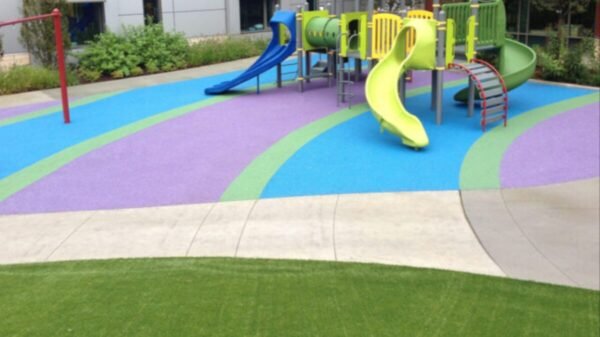
Playground surfacing can make or break a play space. After all, it’s not just about looks, right? It’s about safety: most playground injuries are a result of falls, and the surface material plays a big role there. It’s also about maintenance: you don’t want a ground cover that you’ll have to constantly replace or repair within a short time. The most common playground surfacing options are poured-in-place rubber, turf, and tiles. This article will look at the strengths and trade-offs of each.
Poured-in-Place: Soft, Seamless, Accessible
Many playgrounds today offer ground cover options like sand, mulch, or even recycled pieces of tires. While each has its benefits, they can all also cause lots of problems for kids and families. Loose surfacing can become a compact, hard surface. On the flip side, it can scatter across the playground, creating a maintenance nightmare. And accessibility is a non-starter. Kids in wheelchairs or who have trouble balancing likely can’t even function on these surfaces.
Poured-in-place rubber is the solution to all of these problems. The material is made with a two-layer system. The base layer is recycled rubber, and the top layer typically comes in colored granules. When the rubber is installed, it forms a cushioned surface that reduces the impact of falls from kids’ commercial swing sets and structures. It’s also seamless and even, so kids of all abilities can run, jump, and wheel across to their delight.
Best fit: poured-in-place rubber is ideal for schools and churches looking for long-term, low-maintenance surfacing. It meets ADA safety standards, and it’s highly accessible.
Synthetic Turf: Natural and Nice to Play On
There has been a call to nature recently. More and more churches and schools are recognizing the benefits of getting kids out into nature to touch grass, plant flowers, and climb trees. But they don’t always have the capacity to maintain fresh grass on school or church grounds. Plus, grass can wear down quickly under running and jumping feet. And during rainy weather, the entire surface can become one big muddy headache.
Synthetic turf is a nice hybrid between nature and practicality. It’s typically installed on playgrounds with shock-absorbing pads under the top layer. This makes for a safer fall as kids inevitably tumble and roll across the surface. And while it’s not exactly “nature,” it will blend into the surrounding environment if the school or church is set in a green area. So you’ll get an option that is both practical and visually appealing.
Best fit: Synthetic turf is perfect for schools and churches seeking more access to nature and green spaces. This option is natural looking, but it can handle heavy use without the need for constant maintenance.
Playground Tiles: Maintenance and Modularity
Many churches and schools find themselves having to upgrade their spaces in phases. In other cases, they need to be able to use a play space for multiple activities. Pour-in-place, in these cases, is too permanent an option, as it must be installed for the long term and cannot be relocated. Likewise, turf is also a long-term surface, and it can be pricey, sometimes beyond the budgets of underfunded organizations.
Enter playground tiles. These modular surface pieces are typically made from recycled rubber and create the same shock absorbing surface you’ll get with pour-in-place. The difference is that you can install the tiles in phases, they can be moved as needed, and they’re usually more affordable. The tiles will lock together like puzzle pieces and hold their form until you need to move them. Plus, when one tile is damaged, you can replace it easily.
Best fit: These tiles are ideal for schools and churches that need a budget-friendly option and/or a phased solution. If you don’t want to commit to permanent installation, these are the way to go.
The Right Option for Your School or Church
Of course, the right option for your community is going to be based on your specific needs. You’ll want to take a look at your budget, your safety needs, and your accessibility concerns. And, of course, you’ll take into consideration how you want the playground to look, overall.
- Poured-in-place is a good fit for safety, accessibility, and minimal maintenance if you can invest in the process up front. It is important to note that rubber surfaces can become extremely hot under direct sunlight. So be sure to include shade structures if you choose this option.
- Synthetic turf will be better if you’re aiming to achieve a natural look and can afford a slightly higher price tag. Do be mindful that you may have more problems with flooding if you’re in a rainier area. Turf surfaces can be more challenging to drain.
- Finally, playground tiles are perfect for any school or church community that needs flexibility and is on a tighter budget.
An Investment In Your Community
In the end, choosing a playground surface is individual to the needs and aesthetics of your school or church. And the truth is, you can’t really go wrong. With each option, you’ll be addressing safety concerns, and you’ll make the play space more accessible to the kids. Whether you choose a natural look, a permanent pour-in-place, or modular tiles, your community is bound to love the upgrade. And the kids will relish their fresh new activity space.